



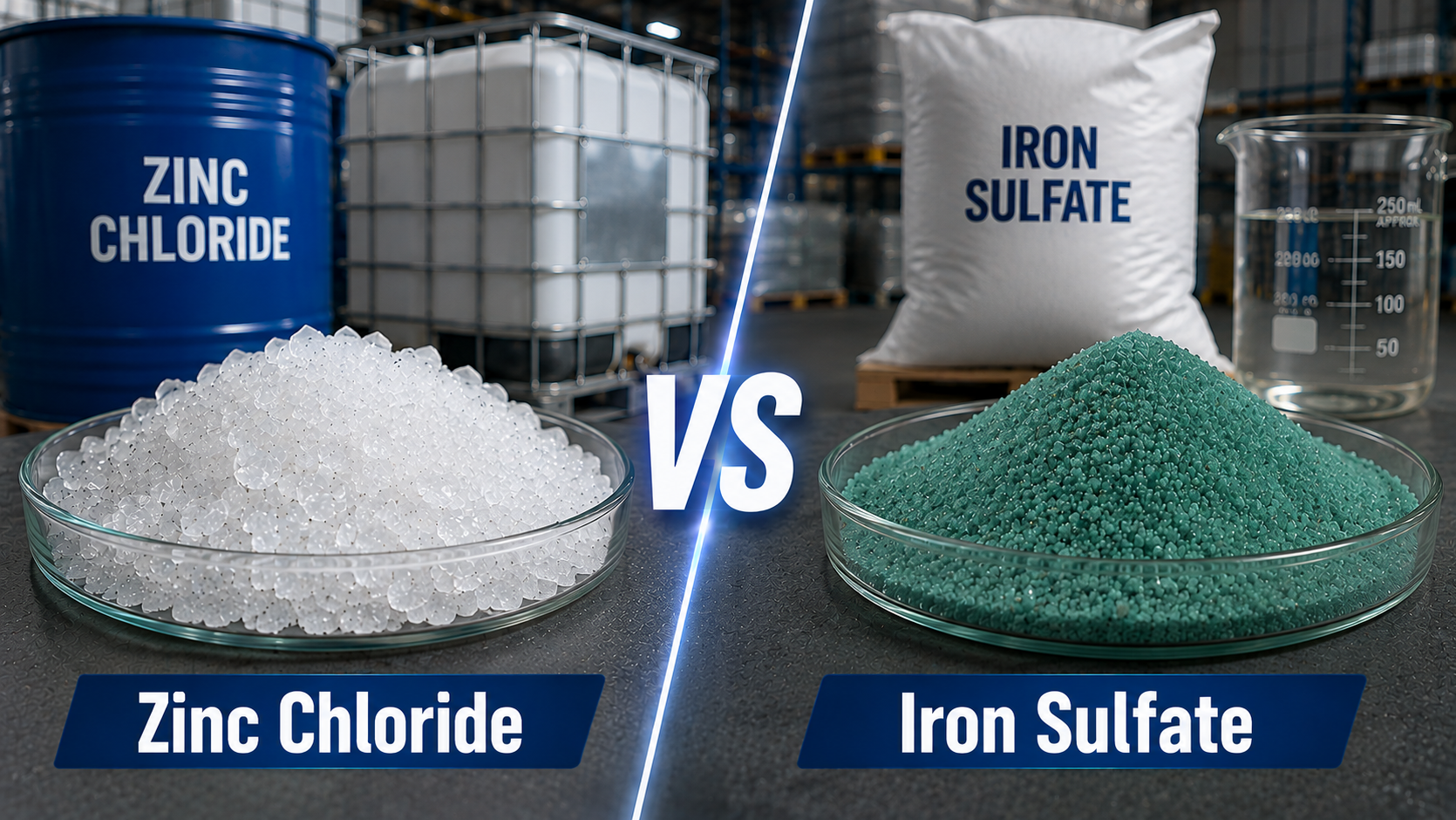
If you searched zinc chloride vs iron sulfate, there’s a good chance you’re evaluating industrial chemical inputs for a water treatment line, a metal processing shop, or a broader procurement program and want to know if these two are interchangeable. They aren’t, and understanding why will save you from ordering the wrong chemical or paying for capability you don’t need.
Zinc chloride and iron sulfate are both common inorganic salts used across heavy industry, but they were never built to compete for the same job. One is a multi-purpose industrial chemical used in metal treatment, batteries, and chemical synthesis. The other is a workhorse water-treatment coagulant. This guide breaks down what each one actually does, where their paths genuinely cross, and what a first-time buyer sourcing either from China should check before placing an order.
Zinc Chloride vs Iron Sulfate: Quick Comparison
| Zinc Chloride (ZnCl₂) | Iron Sulfate (FeSO₄) | |
|---|---|---|
| Primary role | Flux, catalyst, electrolyte, corrosion inhibitor | Coagulant/flocculant, iron supplement |
| Common industries | Metal galvanizing, batteries, chemical synthesis, oil & gas, textiles, rubber, paper | Municipal & industrial water treatment, agriculture, cement additives |
| Form | White crystalline granules or pearls, or liquid solution | Pale green crystals or granules |
| Solubility | Highly soluble, deliquescent (absorbs moisture from air) | Soluble, less hygroscopic than zinc chloride |
| Grades typically sold | 95% industrial, 98% battery/high-purity | Technical/agricultural grade, various hydrate forms |
| Water treatment role | Corrosion inhibitor, trace metal removal aid | Primary coagulant for turbidity and phosphorus removal |
| Typical packaging | 25kg bags, 1,000kg jumbo bags | Bulk bags, drums, or bulk powder |
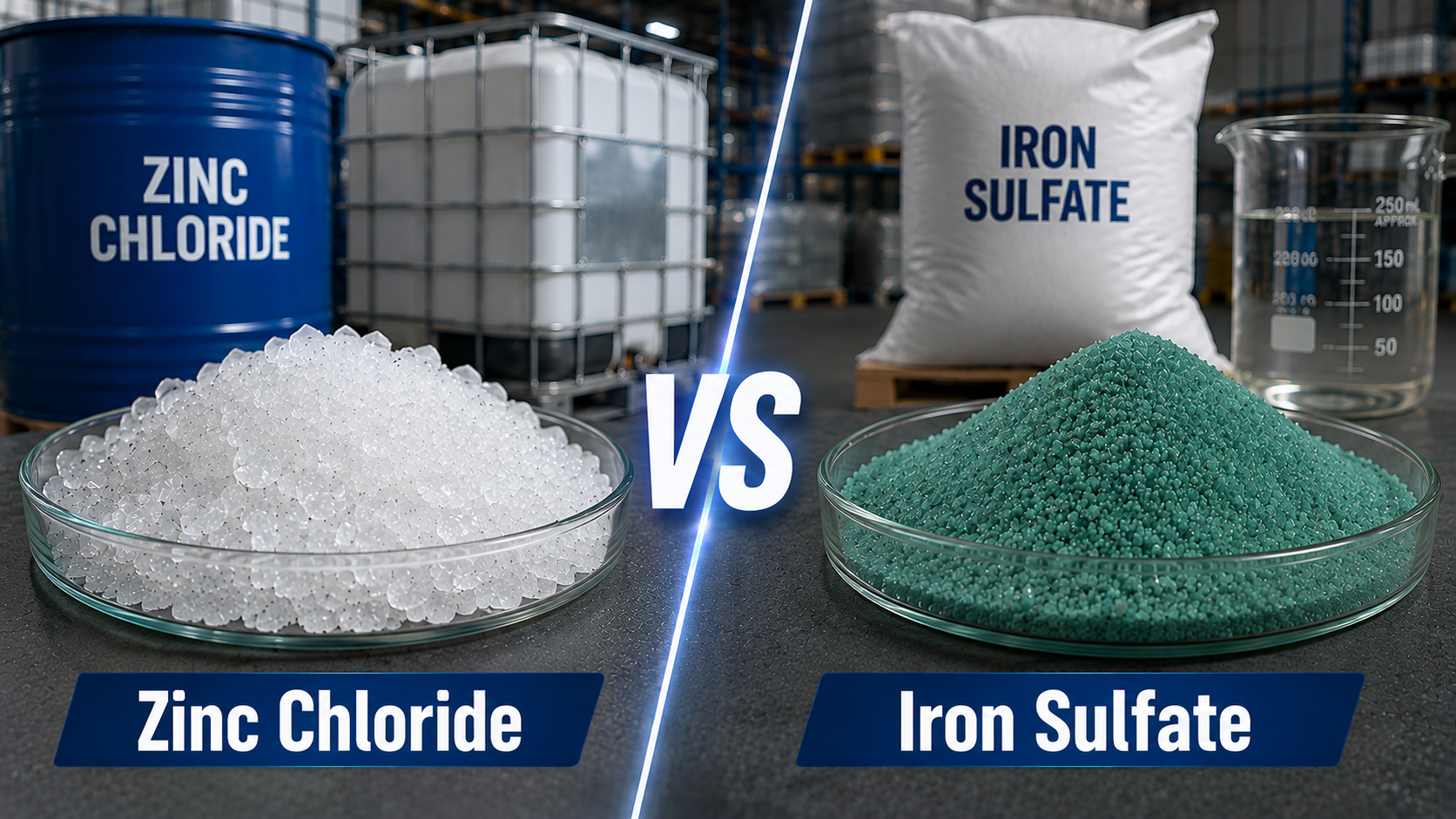
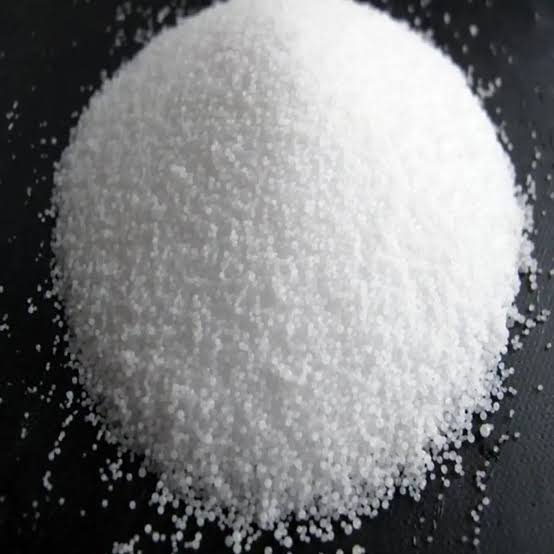
Zinc Chloride vs Iron Sulfate: A visual comparison of two zinc compounds used across different industrial applications.
What Zinc Chloride Actually Does
Zinc chloride (ZnCl₂) is a white, highly soluble, deliquescent crystalline compound sold industrially as 95% industrial grade or 98% high-purity grade. Full parameter data, including iron, sulfate, and heavy metal impurity limits for both grades, is available on our specifications page.
Its core industrial roles include:
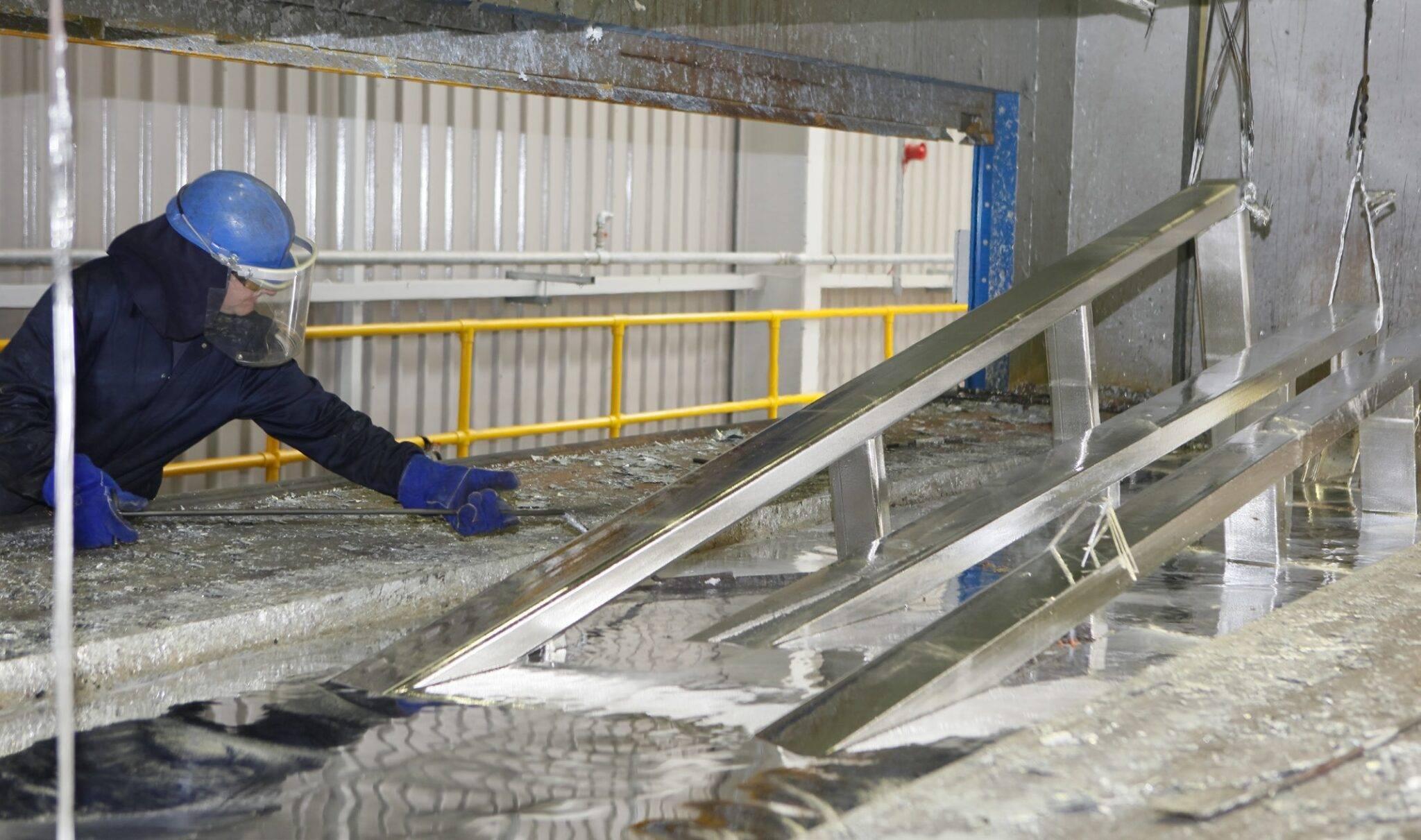
- Metal processing & galvanizing — used as a flux to strip oxides from steel before hot-dip galvanizing, covered in detail in our galvanizing flux guide
- Battery manufacturing — a high-purity electrolyte component in dry cell (Leclanché) battery production
- Chemical synthesis & catalysis — functions as a Lewis acid catalyst and dehydrating agent in organic synthesis
- Oil & gas — stabilizes clay in drilling fluids and assists in oil-water separation
- Textile, rubber, and paper processing — fixes dyes, accelerates vulcanization, and improves paper surface quality
Grade Selection: 95% vs 98%
Buyers new to sourcing often assume higher purity is automatically better — it isn’t; it’s just more expensive and suited to different work. Our 95% vs 98% grade comparison breaks this down in full, but the short version: 95% industrial grade covers galvanizing, textiles, and general industrial use, while 98% high-purity grade is reserved for battery electrolyte and pharmaceutical-adjacent applications where trace iron and heavy metal content matter far more.
What Iron Sulfate Actually Does
Iron sulfate (most commonly ferrous sulfate, FeSO₄, or ferric sulfate, Fe₂(SO₄)₃) is best known as an inorganic coagulant in municipal and industrial water treatment. It works by neutralizing the negative charge on suspended particles in water, causing them to clump together (flocculate) so they can be settled or filtered out — you can review the compound’s full chemical profile on PubChem, an authoritative public chemical database. It’s also used as a soil and turf iron supplement in agriculture and, in cement manufacturing, as a chromate reducer.
Iron sulfate is not something CamaZincChloride manufactures or sells — we’re covering it here strictly for buyer context, so you can see clearly where it does and doesn’t overlap with the chemical we do supply.

Industrial water treatment facilities often use multiple chemicals across different treatment stages.
Where They Actually Overlap: Industrial Water Treatment
This is the one place a buyer might genuinely wonder whether to choose one or the other — and the honest answer is that they typically aren’t chosen instead of each other; they solve different problems within the same water system.
Iron sulfate is the coagulant. It’s dosed early in the treatment process to pull suspended solids, organic matter, and phosphorus out of raw water or wastewater.
Zinc chloride shows up differently — as a corrosion inhibitor in cooling water and metal-equipment systems and in specialized processes to help remove trace impurities and neutralize certain wastewater contaminants, as noted on our application page. It isn’t a coagulant, and it isn’t positioned to replace one.

Dosing equipment for industrial water treatment chemical programs.
Decision-Maker Insight: If your plant is choosing a primary coagulant, iron sulfate (or an alternative like ferric chloride, aluminum sulfate, or PAC) is the relevant conversation — not zinc chloride. Where zinc chloride earns its place in a water program is on the equipment-protection side: corrosion control in cooling loops and heavy-metal-related purification steps. Buying the wrong chemical for the wrong stage of your water system wastes budget and doesn’t solve the problem you actually have — get clear on which stage you’re treating before you request quotes.
We do have one real case study touching this segment: a municipal water authority in Brazil switched to our 95% industrial-grade zinc chloride, on a repeat order of 100 tons twice a year, to help remove heavy metals from drinking water sources ahead of new regulatory requirements, a purification role, not a coagulation one. You can read more in our success stories.
Talk your water treatment chemical mix through with our team directly:
WhatsApp Us for Free a Consultation
Where They Never Overlap
Outside water treatment, these two chemicals don’t compete at all:
- Metal galvanizing and electroplating — zinc chloride only; iron sulfate has no fluxing role here
- Battery electrolytes — zinc chloride only
- Chemical synthesis catalysis — zinc chloride only
- Agricultural soil iron supplementation, cement chromate reduction — iron sulfate only
If a supplier tries to position iron sulfate as a substitute for zinc chloride flux, catalyst, or electrolyte applications, treat that as a red flag on their technical competence, not a cost-saving tip.
Zinc chloride’s role as a Lewis acid catalyst has no equivalent use case for iron sulfate.
Technical Note: Chemically, the difference comes down to the metal ion doing the work. Zinc chloride’s Zn²⁺ ion acts as a Lewis acid — it accepts electron pairs, which is exactly what makes it useful as a catalyst and as a flux that strips metal oxides. Iron sulfate’s Fe²⁺ or Fe³⁺ ion works through charge neutralization and hydrolysis, forming iron hydroxide flocs that trap suspended particles — the mechanism coagulation depends on. Neither ion can substitute for the other’s chemistry, which is why these two chemicals sit in almost entirely separate parts of an industrial buyer’s chemical list.
Bulk Procurement Checklist for Either Chemical
Whether you’re sourcing zinc chloride, iron sulfate, or both as part of a broader industrial chemical program from China, the same due-diligence basics apply:
- Confirm the exact grade and parameter sheet — don’t accept a generic “industrial grade” label without a COA showing actual purity and impurity limits
- Ask for real certifications — ISO 9001, SGS third-party testing, REACH compliance, and a batch-specific MSDS
- Check UN packaging compliance — zinc chloride ships as UN 2331, Class 8, typically in 25kg or 1,000kg moisture-resistant bags
- Request a small sample before bulk commitment — 500g to 1kg is standard for pre-order quality testing, covered in our purity testing guide
- Verify the factory is real — ask about factory visit access; a supplier that hesitates here is a warning sign, not a scheduling inconvenience
Parameter comparison across zinc chloride grades.
If this is your first time importing industrial chemicals from China, our first-time importer’s guide walks through the process step by step, and our verified supplier guide covers how to vet a factory versus a trading middleman.
Buyers in Africa, Asia, or South America can reach our team here:
WhatsApp Us for Free a Consultation
Ready to Buy Zinc Chloride From a Verified Source?
Contact our team today for a quotation, sample, and delivery timeline.
Australia, Europe, North America:
WhatsApp Us for Free a Consultation
Africa, Asia, South America:
WhatsApp Us for Free a Consultation
Zinc Chloride in Industrial Applications: See It in Action! Want to see how zinc chloride is used in a real industrial setting? Check out this short video. It demonstrates its crucial role in the metal treatment process.
FAQ
Is zinc chloride a substitute for iron sulfate in water treatment?
No. Iron sulfate is a coagulant used to remove suspended solids and phosphorus from water. Zinc chloride is not a coagulant — its role in water treatment is corrosion inhibition and trace impurity removal. They address different stages of a water treatment process.
Can zinc chloride and iron sulfate be used together in the same water system?
Yes, in the sense that a plant might use iron sulfate as its primary coagulant and separately use zinc chloride for corrosion protection in cooling loops or equipment. They aren’t blended for the same dosing step.
Which is cheaper, zinc chloride or iron sulfate?
Pricing depends on grade, volume, and current raw material markets rather than a fixed rule. Since the two chemicals rarely compete for the same application, price comparison usually isn’t the relevant question — grade fit for your process is.
Does CamaZincChloride supply iron sulfate?
No. We supply zinc chloride exclusively, in 95% industrial and 98% high-purity grades. This guide covers iron sulfate for buyer context only.
What certifications should I request when sourcing zinc chloride from China?
Ask for ISO 9001, SGS third-party test reports, REACH compliance documentation, and a batch-specific Certificate of Analysis (COA) and MSDS. See our supplier certifications guide for the full checklist.
Conclusion
Zinc chloride and iron sulfate are both established industrial chemicals, but they were built for different jobs. Iron sulfate earns its place as a water treatment coagulant. Zinc chloride earns its place across galvanizing, batteries, chemical synthesis, and within water treatment specifically — corrosion control and impurity removal rather than coagulation. If your process needs a flux, a catalyst, a battery electrolyte, or a corrosion inhibitor, zinc chloride is the chemical to source; if you need a primary water coagulant, that’s a separate conversation entirely. Either way, the sourcing fundamentals are the same: verified grade data, real certifications, and a supplier willing to prove it.
Industrial Buyers: Next Steps for Sourcing Bulk Zinc Chloride
What makes our Zinc Chloride Better:
✅ Compliant with EU, UN, ISO Standards – No Legal Headaches
✅ Guaranteed Purity – Stability for your Processing Plant
✅ Batch-Specific COA Provided – Full Transparency per Shipment.
Download Our EU-approved FREE COA & Specifications. Specifications Page