




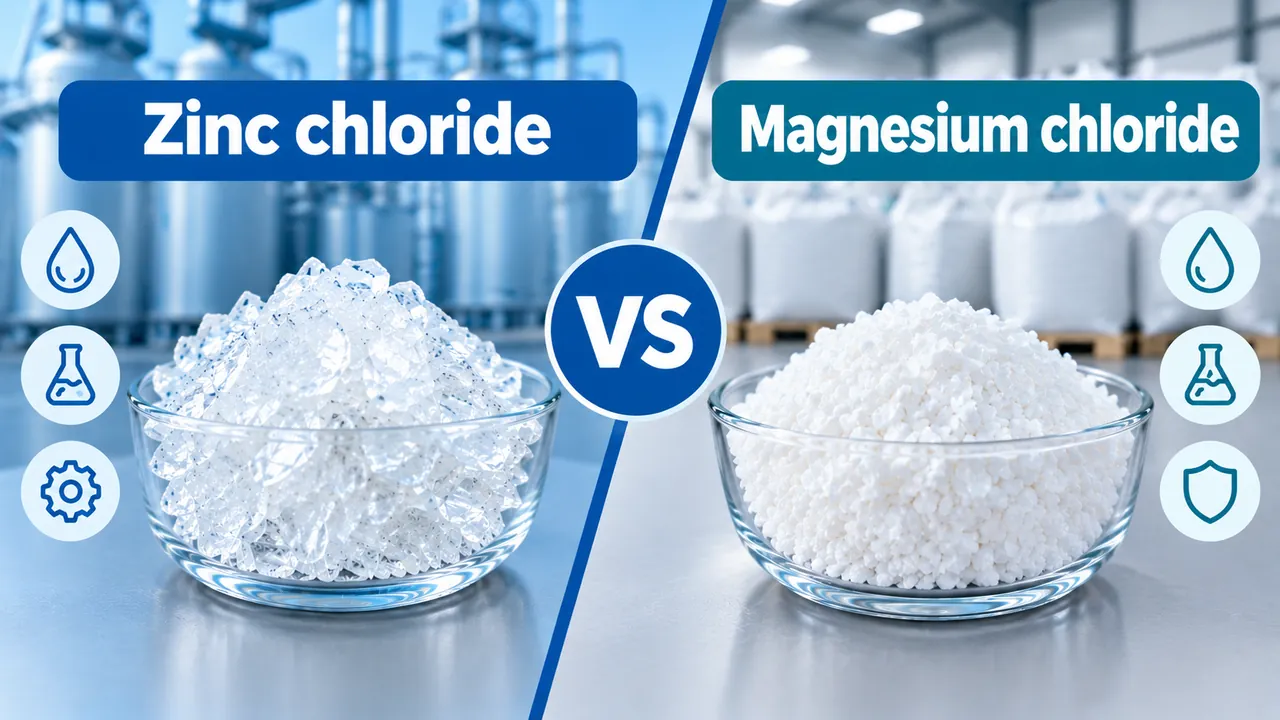
Zinc chloride vs magnesium chloride: a visual comparison of two industrial chloride chemicals.
If you’re comparing zinc chloride vs magnesium chloride for an industrial application, the two get grouped together more than you’d expect — both are highly soluble metal chloride salts, both ship in bulk from China, and both show up across water treatment, construction, and de-icing conversations. But they serve genuinely different purposes, and picking the wrong one wastes budget on a chemical that doesn’t fit your process.
This guide breaks down what each one actually does, where they overlap, and how to think about sourcing whichever one your application needs.

Zinc chloride’s core industrial uses center on galvanizing, water treatment, and battery manufacturing.
What Is Zinc Chloride?
Zinc chloride (ZnCl₂) is a highly water-soluble salt used across galvanizing, water treatment, textile processing, oil & gas, and battery manufacturing. Explore our zinc chloride applications before selecting a grade for your process. It’s sold in two standard grades:
- 95% industrial grade — galvanizing flux, water treatment, textiles, oil & gas
- 98% high purity grade — battery electrolyte production, higher-purity chemical synthesis
Decision-Maker Insight: If your process only needs 95% grade, don’t overpay for 98% battery-grade material — the full parameter data confirms industrial-grade zinc chloride meets galvanizing and water treatment specs without it.
What Is Magnesium Chloride?
Magnesium chloride (MgCl₂) is a highly soluble, hygroscopic salt most commonly supplied as the hexahydrate form. Its industrial footprint is different from zinc chloride’s — it’s used in:
- De-icing and dust control — road de-icer effective to roughly -13°F, and unpaved road dust suppression
- Construction — magnesia (Sorel) cement, magnesium oxide/hydroxide production, foamed concrete
- Oil & gas — component in drilling fluids and kill muds
- Food processing — tofu coagulant and mineral fortification
- Emerging use — magnesium-ion battery research
Unlike zinc chloride’s straightforward 95%/98% split, magnesium chloride buyers most often deal with the food/USP-grade vs. industrial/technical-grade distinction, and whether they need flake, pearl, or hexahydrate form.
Zinc Chloride vs Magnesium Chloride: Side-by-Side Comparison
| Factor | Zinc Chloride (ZnCl₂) | Magnesium Chloride (MgCl₂) |
|---|---|---|
| Common grades | 95% industrial, 98% high purity | Technical/industrial, food/USP grade |
| Primary industries | Galvanizing, water treatment, battery, textiles, oil & gas | De-icing, construction/cement, oil & gas drilling fluids, food processing |
| Common form | Anhydrous solid powder | Flakes, pearls, or hexahydrate crystals |
| Solubility in water | Very high | Very high, strongly hygroscopic |
| Typical order volume | 25 tons (1 container) and up | Varies widely — bulk de-icing orders can run much larger |
| Packaging standard | UN 2331, Class 8 — 25kg bags, 1,000kg jumbo bags | Typically non-hazmat, bagged or bulk |
Where the Two Overlap
Both chemicals show up in water treatment and drilling fluid applications, which is the most common point of direct comparison. Zinc chloride is used in specific water treatment processes and as a heavy-density completion fluid component in oil & gas; magnesium chloride is more commonly used in drilling fluids and kill muds, and separately as a coagulant elsewhere in water treatment. Outside that overlap, the two diverge sharply — zinc chloride has no meaningful role in de-icing or cement production, and magnesium chloride isn’t used as a galvanizing flux or battery electrolyte the way zinc chloride is.
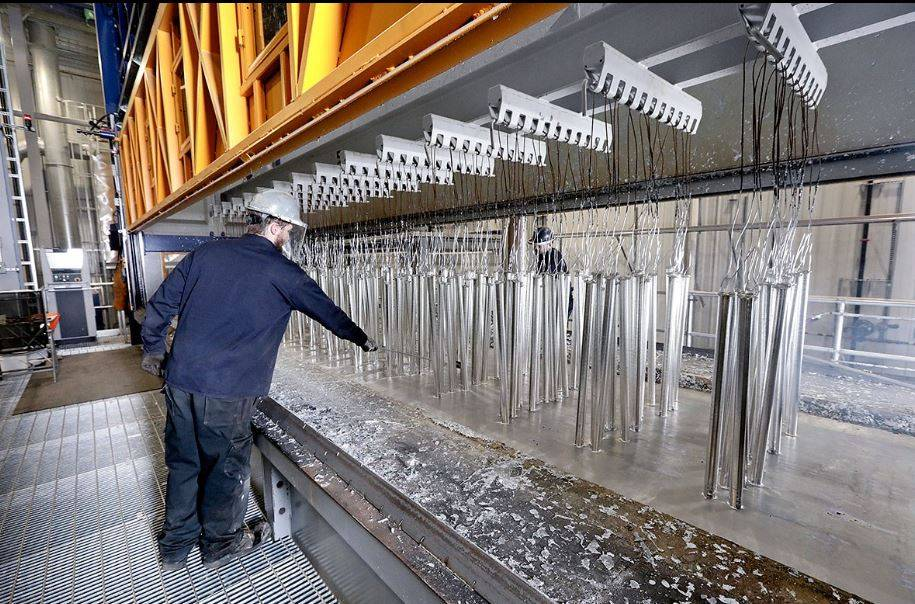
Zinc chloride’s flux role in galvanizing has no magnesium chloride equivalent.
Technical Note: Zinc chloride’s flux action works by cleaning oxide layers off steel before galvanizing — a role tied specifically to zinc chemistry. Magnesium chloride’s industrial value instead comes from its strong hygroscopic (moisture-attracting) and freeze-point-lowering properties, which is why it dominates de-icing and drilling fluid applications zinc chloride doesn’t touch. These are functionally separate chemistries, not interchangeable substitutes.
Ready to Buy Zinc Chloride From a Verified Source?
Contact our team today for a quotation, sample, and delivery timeline.
WhatsApp Us for Free a Consultation
How to Choose Between Them
- What is the actual function you need? Metal bonding/coating, water treatment, or battery electrolyte — zinc chloride. De-icing, dust control, cement production, or drilling fluid density — magnesium chloride.
- What grade/purity does your spec require? Confirm technical vs. food/USP grade for magnesium chloride, and 95% vs. 98% for zinc chloride — these aren’t interchangeable within either chemical’s own product line.
- What form do you need? Zinc chloride ships mainly as anhydrous powder; magnesium chloride commonly ships as flakes, pearls, or hexahydrate — confirm this matches your handling process before ordering.
Sourcing Either Chemical From China: What First-Time Importers Should Check
Whether you land on zinc chloride or magnesium chloride, the sourcing risks are similar. Before committing to a supplier:
- Confirm it’s a factory, not just a trading company. A legitimate China-based manufacturer won’t hesitate on a factory visit or live video walkthrough.
- Request a Certificate of Analysis (CoA) per batch, not a generic spec sheet.
- Check for ISO 9001, SGS, and REACH certification before assuming compliance.
- Start with a sample. A small pre-bulk sample is standard practice for verifying quality before a full container order.

Quality testing and batch documentation help buyers verify chemical consistency before a bulk order.
Decision-Maker Insight: The real cost of a bad sourcing decision usually isn’t the unit price — it’s a failed shipment or a batch that doesn’t meet your downstream spec. Our Poland steel galvanizing success story shows why verifying the supplier upfront matters before committing to bulk supply.
Want to See Zinc Chloride in Industrial Use?
Want to see how zinc chloride is used in a real industrial setting? Check out this short video.
Ready to move forward? Reach out directly and we’ll walk you through grade selection, sample options, and lead times.
WhatsApp Us for Free a Consultation
Frequently Asked Questions
Is zinc chloride the same as magnesium chloride?
No. They’re different metal chloride compounds with different industrial roles. Zinc chloride is used in galvanizing, water treatment, and battery production; magnesium chloride is used mainly in de-icing, cement/construction, and drilling fluids.
Can magnesium chloride replace zinc chloride in galvanizing flux?
No. Zinc chloride’s flux action relies on zinc-specific chemistry with steel surfaces. Magnesium chloride is not used for this purpose.
Which is more expensive, zinc chloride or magnesium chloride?
This depends heavily on grade and form — magnesium chloride’s bulk de-icing grade is typically lower cost per ton than either zinc chloride grade, while food/USP-grade magnesium chloride can run higher. Always compare quotes on matched grade and form, not just a headline price.
Do I need 95% or 98% zinc chloride grade?
Most galvanizing, water treatment, and textile applications use 95% industrial grade. Battery manufacturing and higher-purity chemical synthesis typically require 98% battery grade. Full parameter details here.
What should first-time importers check before ordering either chemical in bulk?
A batch-specific Certificate of Analysis, MSDS, confirmed ISO 9001/SGS/REACH certification, and — common mistakes to avoid — clarity on MOQ terms before committing.
Conclusion
Zinc chloride and magnesium chloride get compared occasionally because both are common bulk metal chloride salts sourced from China, but the overlap in actual use is narrow. The right choice comes down to function: metal treatment and battery work point to zinc chloride, while de-icing, cement, and drilling fluid work point to magnesium chloride. Once you’ve confirmed the right chemical, the sourcing checklist is the same either way — verify the factory, request real documentation, and start with a sample before committing to bulk.
Industrial Buyers: Next Steps for Sourcing Bulk Zinc Chloride
What makes our Zinc Chloride Better:
✅ Compliant with EU, UN, ISO Standards – No Legal Headaches
✅ Guaranteed Purity – Stability for your Processing Plant
✅ Batch-Specific COA Provided – Full Transparency per Shipment.
Download Our EU-approved FREE COA & Specifications. Specifications Page