



A Zinc Chloride COA is the one document that turns a seller’s promise into proof. Before you wire a deposit for your first container, this is the page you should be reading line by line, not the sales brochure.
Most first-time buyers have seen dozens of zinc chloride listings that all say “high purity” and “SGS tested”. Only one document actually backs that claim with numbers: the Certificate of Analysis. This guide breaks down exactly what’s on it, how the 95% and 98% grades differ on paper, and the red flags that tell you a COA was copy-pasted rather than tested.

A legitimate spec sheet should match what’s in the bag: clean white crystals, not a discolored or clumped product.
WhatsApp Us for Free a Consultation
Why the COA Matters More for a China Buyer
If you’re buying from a domestic supplier, a shaky COA is annoying. If you’re buying your first container from a factory in China you’ve never visited, it’s the difference between a good decision and a very expensive one.
You can’t walk over and check the lab yourself. You can’t call a rep you’ve worked with for years. The COA — cross-checked against real certifications, is your stand-in for all of that.
- No existing relationship with the factory
- No easy way to verify quality claims remotely
- Dozens of competing listings all making the same promises
A real COA, read correctly, answers the question every first-time importer is really asking: why should I trust this supplier over the hundred other listings?
What Is a Zinc Chloride COA?
A Certificate of Analysis is a document issued by a manufacturer or testing lab that reports the actual test results for a specific production lot of zinc chloride — not the general spec sheet, but what that batch measured when it was tested.
It typically ties together:
- The exact grade (95% industrial or 98% high-purity)
- The lot or batch number
- Test results for purity and key impurities
- The specification limits each result is measured against
- Dates of manufacture and testing
Think of the general specifications page as the promise and the COA as the receipt for one specific shipment.
Zinc Chloride COA vs. SDS/MSDS: Not the Same Document
Buyers new to chemical imports sometimes assume one safety document covers everything. It doesn’t.
| Document | What It Tells You | When You Need It |
|---|---|---|
| COA | Actual test results for this batch (purity, impurities) | Before accepting a shipment, to confirm quality |
| MSDS/SDS | Handling, storage, and hazard information | Before storing or handling the chemical on-site |
| Specification sheet | The general promise for the grade | Before choosing 95% vs 98% |
You need all three for a smooth import. The COA is the one that’s specific to your actual order — never the same for two different lots.
What a Legitimate Zinc Chloride COA Contains
A real COA isn’t a marketing PDF. It’s a structured report. Here’s what should be on it.
Identification Fields
- Product name and CAS number (7646-85-7 for zinc chloride)
- Lot or batch number: this is the field that links the paper to the physical bags on your dock
- Manufacture date and retest date
- Country of origin
The Test Results Table
This is the core of the document: a grid comparing the specification (the acceptable limit) against the result (what that batch actually measured). For zinc chloride, that typically covers assay, iron, sulfate, heavy metals, and water insolubles.
Sign-Off
A legitimate COA is approved by a named quality control representative, not left blank or unsigned. If a COA has no signature and no dated approval, treat it as a draft, not proof.

A COA carries more weight when it’s backed by an ISO 9001-certified quality system.
WhatsApp Us for Free a Consultation
95% Industrial Grade vs. 98% Battery Grade: What Changes on the COA
The single biggest grade-selection question we get from first-time buyers is which purity level their process actually needs and the COA is where that decision gets confirmed in numbers, not marketing language.
| Parameter | 95% Industrial Grade | 98% High-Purity Grade |
|---|---|---|
| Zinc Chloride (ZnCl₂) | Min 95.0% | Min 98.0% |
| Iron (Fe) | Max 0.05% | Max 0.001% |
| Sulfate (SO₄²⁻) | Max 0.05% | Max 0.01% |
| Water Insolubles | Max 0.1% | Max 0.05% |
| Heavy Metals (as Pb) | Max 0.05% | Max 0.002% |

The 98% grade’s tighter iron and heavy-metal limits are what a COA is checking for on a battery-grade order.
When 95% Is the Right Call
Steel galvanizing, general water treatment, oil and gas, and textile processing rarely need the tighter iron and heavy-metal limits of the 98% grade. Full application details are on our application page.
When 98% Is Worth the Premium
Battery manufacturing and sensitive chemical synthesis usually require the tighter trace-metal ceilings — a stray iron or lead reading well within the 95% spec can still be too high for a battery electrolyte. If you’re unsure which grade your process needs, our 95% vs 98% grade comparison walks through it application by application.
Decision-Maker Insight
A COA that shows the wrong grade’s limits for what you ordered is one of the fastest ways to catch a mismatched or mislabeled shipment before it costs you a batch of finished product. Always confirm the grade on the COA header matches your purchase order — not just the price you were quoted.
How to Read the Specification vs. Result Columns
Reading a COA is mechanical once you know the pattern. Four checks, every time:
- Match the lot number on the COA to the lot number printed on the bags. A COA for the right product but the wrong lot proves nothing about what’s on your dock.
- Compare result to specification, not to a general claim. If the spec says “Iron: Max 0.05%” and the result reads 0.03%, that line passes.
- Check the test date against your shipment date — a COA that’s years old, or has no date, should raise a question.
- Confirm the grade in the header (95% or 98%) matches what you actually ordered.
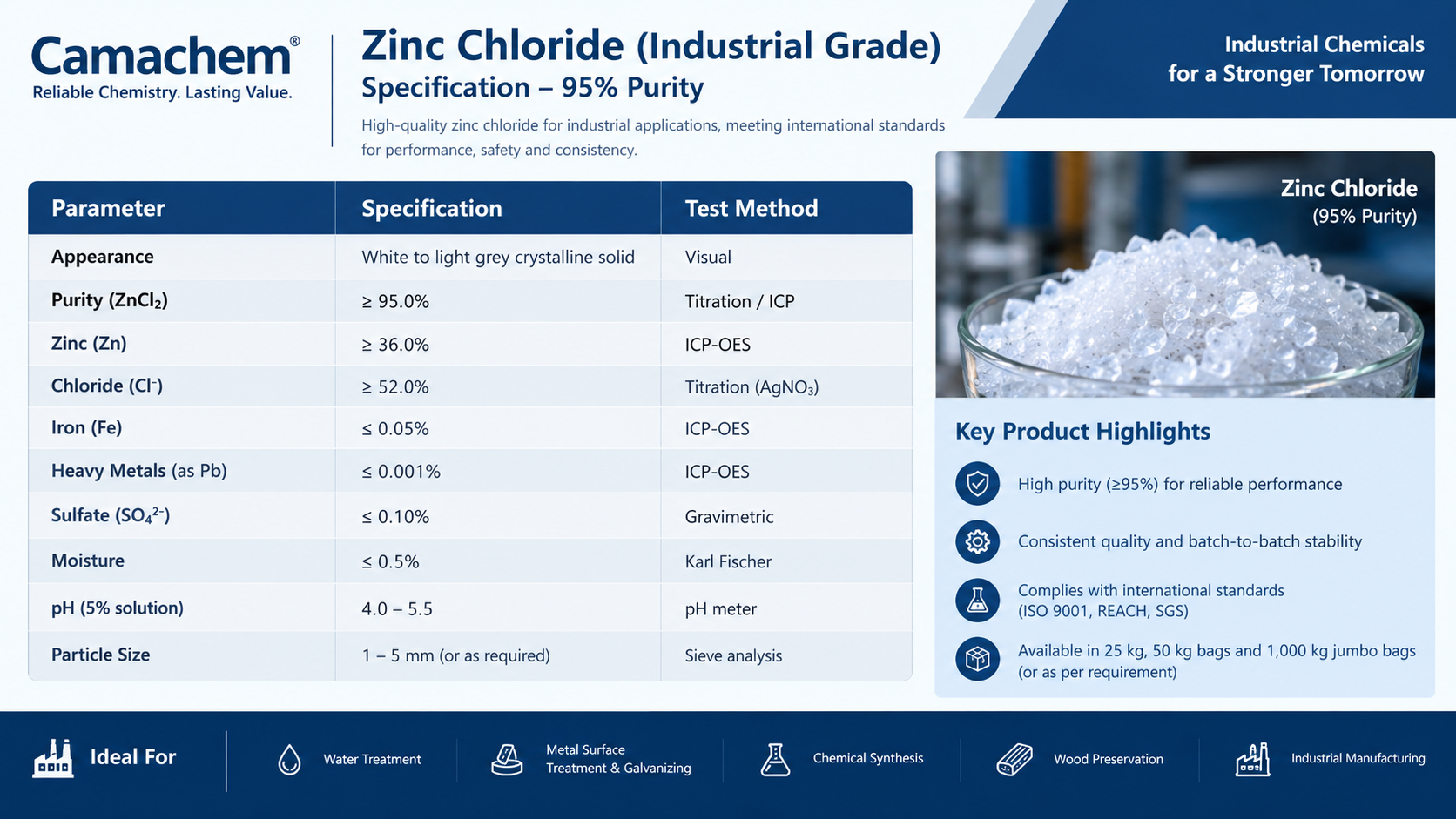
When you read a COA’s result column, this is the specification table you’re checking it against for the 95% grade.
WhatsApp Us for Free a Consultation
Red Flags: How to Spot a Fake or Copy-Pasted COA
Not every COA circulating online is genuine. First-time importers dealing with unfamiliar trading companies should watch for these signs.
- “Typical” values instead of real numbers. A genuine COA reports the actual result for that lot — not a generic “conforms” or “typical” placeholder.
- No lot number, or a lot number that doesn’t match the shipment.
- No signature or approval date from a quality control representative.
- Results that sit suspiciously exactly on every limit — real batches rarely land precisely at the maximum or minimum for every single parameter.
- The same PDF reused across multiple unrelated orders — a giveaway that a trading company is recycling one document rather than issuing one per lot.
Many of these red flags trace back to a deeper issue: not knowing whether you’re dealing with the actual factory or a reseller repackaging someone else’s documentation. Our guide on factory vs. trading company explains how to tell the difference before you order.

Independent purity testing on a pre-bulk sample is how you confirm a COA’s numbers before scaling to a full container.
WhatsApp Us for Free a Consultation
How We Verify Quality Before the COA Even Ships
A COA you receive after a container leaves the port is the last line of defense, not the first. We build verification in earlier:
- Sample testing first. We offer 500g–1kg samples so you can run your own pre-bulk testing before committing to a full container.
- SGS and BV-certified testing on production batches, not just internal self-reporting.
- Factory visits welcome. We invite qualified buyers to see the production process directly rather than take documentation on faith.
- A COA issued per batch, not a template reused across every shipment.
A South African galvanizing customer switched to our SGS-tested 98% grade after struggling with inconsistent documentation from a previous overseas supplier — one of several success stories from buyers who made the same first-order trust decision you’re weighing now.
This is the same standard our sister company Camachem applies across its wider industrial chemical portfolio — documentation tied to the actual batch, not a boilerplate.

Packaging labels should match the grade and lot number stated on the COA — check both before you sign off on delivery.
Technical Note
Request the COA alongside your sample, not only after the bulk order ships. Running your own quick titration or comparing the sample’s assay result against the COA’s stated result is the single fastest way to confirm a supplier’s documentation matches their actual product before you scale to 25+ tons.
WhatsApp Us for Free a Consultation
Certifications That Should Sit Alongside the COA
A COA doesn’t stand alone. On a legitimate bulk order, it should be part of a documentation set that includes:
- ISO 9001 — quality management system certification
- SGS / BV testing — independent third-party verification, not just internal QC
- REACH — required for EU-bound shipments
- MSDS — safety and handling data
- UN 2331, Class 8 compliant packaging documentation for hazmat shipping
For EU-bound shipments, REACH documentation should sit alongside the COA, not replace it.
If a supplier can produce a COA but nothing else on this list, that’s a gap worth asking about before you order. Our post on certifications to check when choosing a supplier covers each of these in more depth, our guide to purity testing covers what to check beyond the COA itself, and our guide to common first-time buyer mistakes covers the documentation gaps that trip up new importers most often.
For the underlying chemical identity data referenced on any legitimate COA, the PubChem entry for zinc chloride (CAS 7646-85-7) is a reliable independent reference.

Certifications like SGS and ISO 9001 back up what the COA reports — ask for both, not just one.
A Quick Pre-Order COA Checklist
| Check | Why It Matters |
|---|---|
| Lot number matches the shipment | Confirms the paperwork belongs to this batch |
| Grade matches your PO (95% or 98%) | Prevents a mismatched-grade surprise |
| Results shown, not just “conforms” | Proves actual testing occurred |
| Signed and dated by QC | Confirms formal sign-off |
| Backed by SGS/BV or third-party testing | Adds independent verification |
Buyers who are still early in the sourcing process may also find our first-time importer’s guide and our supplier requirements checklist useful alongside this one.
WhatsApp Us for Free a Consultation
Looking to source the Right Zinc Chloride Grade for Your Application?
Contact our team today for a quotation, sample, and delivery timeline.
WhatsApp Us for Free a Consultation
Zinc Chloride in Industrial Applications: See it in Action!
Want to see how zinc chloride is used in a real industrial setting? Check out this short video. It demonstrates its crucial role in the metal treatment process.
FAQ
What does COA stand for in zinc chloride sourcing?
COA stands for Certificate of Analysis — the document reporting actual test results for a specific production lot of zinc chloride, checked against the stated specification.
Is a COA the same as an SDS?
No. A COA reports batch-specific quality and purity results. An SDS (Safety Data Sheet) covers handling, storage, and hazard information. You need both for a complete import file.
Can I get a COA before I place a bulk order?
Yes. A COA should accompany your pre-bulk sample so you can compare it against your own testing before committing to a full container.
What’s the biggest red flag on a zinc chloride COA?
Generic “typical” or “conforms” values instead of actual measured results for the specific lot, and a missing signature or approval date.
Does the COA tell me which grade I need?
No — the COA confirms what a specific batch tested at for a grade you’ve already chosen. Use our 95% vs 98% grade guide to decide on the grade first.
Conclusion
A Zinc Chloride COA is not paperwork you file away unread — it’s the fastest way to confirm that the supplier making promises online can actually back them up with tested numbers. Match the lot, check the results against the spec, confirm the sign-off, and treat any shortcut on those four checks as a reason to ask more questions before you pay a deposit.
Industrial Buyers: Next Steps for Sourcing Bulk Zinc Chloride
What makes our Zinc Chloride Better:
✅ Compliant with EU, UN, ISO Standards – No Legal Headaches
✅ Guaranteed Purity – Stability for your Processing Plant
✅ Batch-Specific COA Provided – Full Transparency per Shipment.
Download Our EU-approved FREE COA & Specifications. Specifications Page