



Zinc Chloride vs. Calcium Chloride: Which Chloride Salt Fits Your Process?
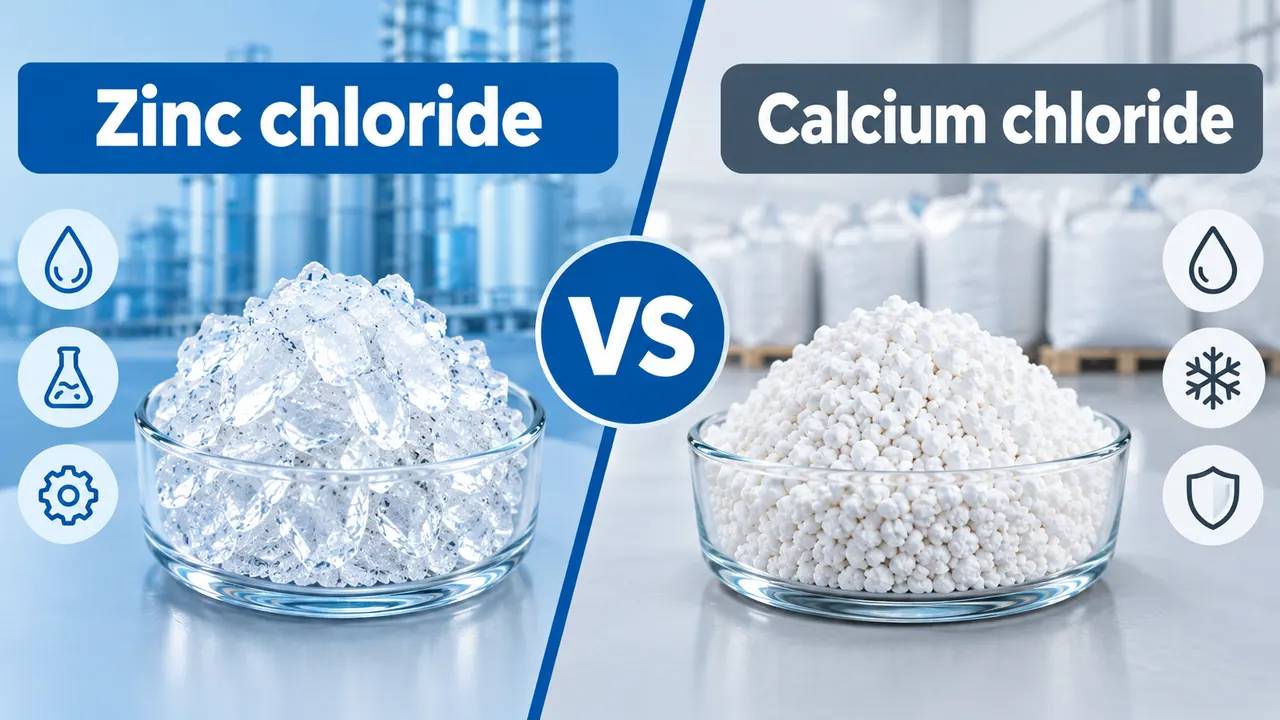
Zinc chloride vs calcium chloride: a visual comparison of two industrial chemicals and their different properties and applications.
Buyers sourcing industrial chemicals from China often end up comparing zinc chloride vs calcium chloride — both are hygroscopic chloride salts, both ship in similar bag and drum formats, and both get grouped together in generic “industrial chloride” searches. But they do very different jobs. Mixing them up in a sourcing decision can mean ordering the wrong chemical entirely.
In short: zinc chloride is a chemically reactive industrial salt used in applications including chemical synthesis, galvanizing, batteries, and specialized water-treatment processes. Calcium chloride is mainly a desiccant and physical-property modifier, used for deicing, dust control, and concrete acceleration. They rarely substitute for each other — this guide breaks down where they differ and where they occasionally overlap. zinc chloride industrial applications
Zinc chloride’s core industrial role is chemical reactivity — not something calcium chloride is built for.
Zinc Chloride vs. Calcium Chloride at a Glance
| Factor | Zinc Chloride | Calcium Chloride |
| Primary function | Lewis acid catalyst, flux, specialized water-treatment applications | Desiccant, deicer, accelerant |
| Core industrial uses | Galvanizing flux, chemical synthesis, batteries, water treatment | Deicing, dust control, concrete acceleration, drying agent |
| Typical grade | 95% industrial / 98% battery-grade | Food, technical, or industrial grade, varies by supplier |
| Reactivity | Chemically reactive (Lewis acid) | Largely non-reactive, physical property modifier |
| Handling class | UN 2331, Class 8 (corrosive) | Generally not classified as hazmat for standard transport |
| Hygroscopicity | Highly deliquescent | Highly deliquescent |
What Is Zinc Chloride Used For?
Catalysis and Chemical Synthesis
Zinc chloride acts as a Lewis acid catalyst in reactions like resin production and organic synthesis. Its reactivity is the entire point — it drives chemical transformations rather than just absorbing moisture. Our zinc chloride as a catalyst page covers specific reaction types in more depth.
Galvanizing Flux
Zinc chloride flux prepares steel surfaces before hot-dip galvanizing, preventing oxidation so the zinc coating bonds properly. Zinc chloride galvanizing applications

Calcium chloride has no equivalent role in galvanizing — this is a purely zinc chloride application.
Specialized Water Treatment
Zinc chloride is used in specialized water-treatment and wastewater processes where its chemical properties can support impurity or contaminant treatment and rust prevention in metal equipment. The specific treatment role depends on the plant’s process chemistry and technical requirements. See our zinc chloride for water treatment page for application details.

Zinc chloride’s specialized water-treatment applications differ significantly from calcium chloride’s typical uses.
Battery Electrolyte
98% battery-grade zinc chloride is used in zinc-carbon battery electrolyte formulations, where purity directly affects battery performance.zinc chloride specifications and impurity limits

Battery-grade purity is a zinc chloride specialty — calcium chloride isn’t used in this application.
What Is Calcium Chloride Used For?
Deicing and Dust Control
Calcium chloride lowers the freezing point of water, which makes it common for winter road deicing and unpaved road dust suppression.
Concrete Acceleration
In construction, calcium chloride speeds up concrete curing time, which is useful in cold-weather pours.
Desiccant and Drying Agent
Because it’s highly deliquescent, calcium chloride absorbs moisture from air and is used in industrial and consumer desiccant products.
Oil and Gas Brine Solutions
High-density calcium chloride brines are used in well completion and workover fluids in the oil and gas industry.
Key Differences Buyers Should Know
Function and Mechanism
Zinc chloride reacts chemically — it catalyzes reactions, precipitates contaminants, and forms metal-ion flux compounds. Calcium chloride mostly changes physical properties like freezing point and moisture content, without reacting with the materials around it. If your process needs a chemical reaction, zinc chloride is likely the right chemical. If your process needs moisture or temperature control, calcium chloride usually is.
Handling and Transport Classification
Zinc Chloride: UN 2331, Class 8
Zinc chloride is corrosive and ships under UN 2331 Class 8 hazmat rules. It needs proper PPE, moisture-resistant packaging, and trained handling.
Calcium Chloride: Generally Non-Hazardous
Calcium chloride is not typically classified as a hazardous material for standard transport, which usually means simpler packaging and shipping requirements. Always confirm current classification with your logistics provider for your specific route, since regulations vary by country. The PubChem safety data for calcium chloride is a useful independent reference.
Cost and Sourcing
Calcium chloride is generally cheaper per ton than zinc chloride, largely because it’s produced at much larger industrial volumes for deicing and oilfield markets. Zinc chloride pricing reflects its higher production complexity and the purity levels needed for catalysis and battery applications.
WhatsApp Us for Free a Consultation
Where the Two Overlap
The main overlap is hygroscopicity: both chemicals absorb moisture readily, which means both need similar moisture-resistant packaging and dry storage conditions regardless of their very different end uses. Beyond that, don’t assume the two are interchangeable in any application.
Decision-Maker Insight: If a supplier proposes calcium chloride as a cheaper substitute for a zinc chloride application — flux, catalysis, or battery use — that’s a red flag, not a cost-saving tip. The two chemicals don’t perform the same chemistry. A wrong-chemical substitution costs far more in failed batches than any per-ton savings.
Technical Note: Confirm your required grade before ordering. Water treatment and general industrial synthesis typically run on 95% industrial-grade zinc chloride, while battery electrolyte production needs 98% battery-grade purity. Full parameter tables are on our specifications page.
Grade selection matters — this is the spec sheet to check before placing a bulk order.
When to Choose Zinc Chloride
Choose zinc chloride when your process needs:
- A Lewis acid catalyst for chemical synthesis
- Flux for hot-dip galvanizing
- A defined zinc chloride function is required in a specialized water-treatment or wastewater process
- High-purity electrolyte for battery production
When to Choose Calcium Chloride
Choose calcium chloride when the goal is deicing, dust suppression, concrete acceleration, or moisture control — none of which are zinc chloride’s strengths. If that’s your actual need, calcium chloride is the correct chemical, not a lesser substitute.
Sourcing Bulk Zinc Chloride From China
Verifying Your Supplier
Before committing to a bulk zinc chloride order, confirm:
- Real certifications (ISO 9001, SGS, REACH, CoA, MSDS)
- A factory that will host a visit or video walkthrough
- A sample policy that lets you test before scaling up
Camachem, our parent company, applies the same factory-verification standard our sister company Camaweigh uses for load and quantity verification across CAMAL Group bulk shipments.Zinc chloride packaging and shipping requirements
Sample-to-Bulk Process
- Consultation — confirm your application and required grade
- Sample — request a 500g sample for pre-bulk testing
- Trial order — start with a smaller container before scaling
- Partnership — move to recurring bulk orders once quality is confirmed
Bulk Procurement Checklist
Before placing a bulk zinc chloride order, confirm:
- Correct application confirmed — zinc chloride, not calcium chloride, is right for your process
- Correct grade selected (95% industrial or 98% battery-grade)
- Certificate of analysis requested for your specific batch
- UN 2331 Class 8 compliant packaging confirmed
- Sample tested against your process before bulk commitment
WhatsApp Us for Free a Consultation
Zinc Chloride in Industrial Applications: See it in Action!
Want to see how zinc chloride is used in a real industrial setting? Check out this short video. It demonstrates its crucial role in the metal treatment process.
Frequently Asked Questions
Can zinc chloride be substituted for calcium chloride in deicing or dust control?
No. Zinc chloride is corrosive, more expensive, and not produced at the scale needed for deicing markets. Calcium chloride is the correct chemical for these applications.
Which is cheaper to import in bulk from China, zinc chloride or calcium chloride?
Calcium chloride is generally cheaper per ton due to larger production volumes. Zinc chloride costs more because of its higher production complexity and purity requirements for catalysis and battery use — but the two aren’t substitutes, so cost comparison alone shouldn’t drive the decision.
Is zinc chloride more hazardous to handle than calcium chloride?
Yes, generally. Zinc chloride is classified UN 2331, Class 8 (corrosive) and needs proper PPE and hazmat-compliant packaging. Calcium chloride is typically not classified as hazardous for standard transport, though you should confirm current rules for your specific shipping route.
Can I use zinc chloride as a desiccant like calcium chloride?
Both chemicals are highly hygroscopic, but zinc chloride’s reactivity and cost make it a poor choice for simple desiccant use compared to calcium chloride, which is purpose-built and priced for that role.
What grade of zinc chloride should I order if I’m switching from calcium chloride in my process?
If you’re switching because your process actually needs a catalytic or coagulant reaction, not moisture control, start with 95% industrial grade for general industrial use, or 98% battery-grade if purity requirements are higher. Confirm with a sample test before ordering in bulk.
Conclusion
Zinc chloride and calcium chloride are both chloride salts, but that’s largely where the similarity ends. Zinc chloride is chemically reactive and is used for functions including catalysis and galvanizing flux, as well as specialized water-treatment applications. Calcium chloride primarily modifies physical properties such as freezing point and moisture content. Know which job your process actually needs before sourcing either one, and always confirm the required grade and specification before placing a bulk order.
Industrial Buyers: Next Steps for Sourcing Bulk Zinc Chloride
What makes our Zinc Chloride Better:
✅ Compliant with EU, UN, ISO Standards – No Legal Headaches
✅ Guaranteed Purity – Stability for your Processing Plant
✅ Batch-Specific COA Provided – Full Transparency per Shipment.
Download Our EU-approved FREE COA & Specifications. Specifications Page