



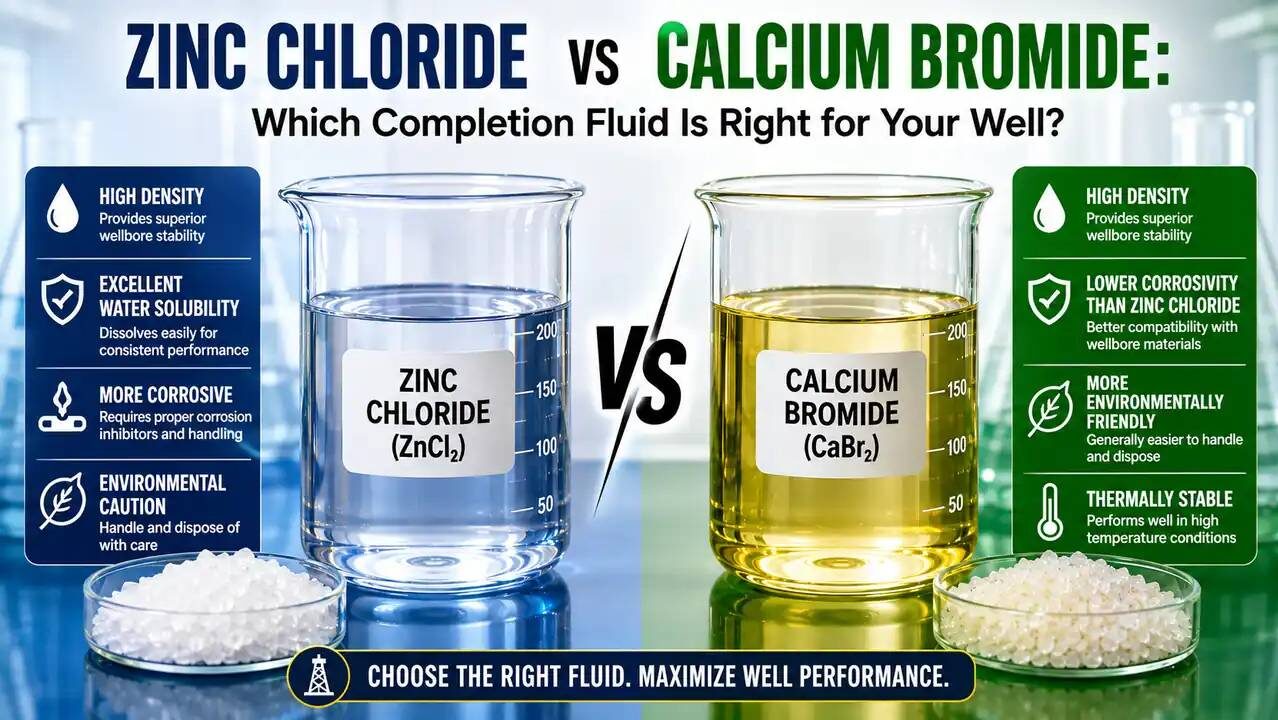
When an oilfield buyer compares zinc chloride and calcium bromide for a completion fluid, the main question is not simply which chemical is better.
The real question is:
Which brine can provide the required density and well control while remaining suitable for the formation, equipment, temperature, and operating conditions?
Calcium bromide is a well-known clear-brine component used in completion and workover operations. Zinc chloride can also be used in high-density completion-fluid systems, including solids-free formulations.
In some cases, the two chemicals can even be used together.
This means zinc chloride and calcium bromide should not always be treated as simple one-for-one substitutes.
Before choosing a completion-fluid system, industrial buyers should consider:
- Required fluid density
- Formation compatibility
- Operating temperature
- Crystallization behavior
- Corrosion risk
- Solids-free performance
- Chemical purity
- Documentation and batch consistency
- Packaging and international logistics

Zinc chloride and calcium bromide are high-density completion-fluid options with different corrosion, compatibility, temperature, and handling considerations.
What Is a Completion Fluid?
A completion fluid is placed in a well during completion, workover, or other well-servicing operations.
The fluid must provide enough pressure to help control the well. At the same time, it should limit damage to the formation and remain suitable for the well’s temperature, pressure, and chemical conditions.
Many operations use clear or solids-free brines instead of fluids containing suspended solids.
This is important because unnecessary solids can create formation damage and cleanup problems.
For high-density wells, salts such as calcium bromide and zinc chloride can be used in concentrated brine systems.
However, reaching the required density is only one part of the decision.
The final fluid must also perform well under the actual conditions of the well.
Zinc Chloride as a Completion-Fluid Component
Zinc chloride is used in several oil and gas applications.
It can also be evaluated as a component in high-density completion-fluid systems.
Why Density Matters
Density affects the amount of hydrostatic pressure a completion fluid can provide.
A higher-density brine can be useful when the well needs greater pressure control without using suspended weighting solids.
However, density should not be the only factor.
A brine may reach the required density but still create problems with corrosion, crystallization, or formation compatibility.
Zinc Chloride and Formation Compatibility
Every reservoir is different.
A zinc chloride brine that works well in one formation may not be suitable for another.
Buyers should therefore test the proposed fluid against the actual formation water and, where needed, the formation material.
This is more useful than choosing a chemical only from a general density chart.
Corrosion Risk
Concentrated brines can create corrosion challenges.
This applies to systems containing both zinc chloride and calcium bromide.
For this reason, the final completion-fluid system may include corrosion inhibitors and other additives.
The complete formulation should be tested under conditions that match the actual well.

Zinc chloride used in a technical fluid formulation should meet the required purity and impurity limits.
Calcium Bromide as a Completion-Fluid Component
Calcium bromide is a well-established component in completion and workover brines.
It can be supplied as a clear aqueous brine for controlling wellbore pressure.
Calcium bromide can also be combined with other salts when a formulation needs different density or crystallization properties.
Why Calcium Bromide Is Widely Used
Calcium bromide can be a practical option when a completion or workover program requires a clear brine with controlled density.
However, it is not automatically suitable for every well.
Before selecting the final formulation, buyers should review:
- Required density
- Operating temperature
- Crystallization point
- Formation compatibility
- Equipment and metallurgy

Completion and workover brines should be selected according to the specific conditions of the well.
Zinc Chloride vs Calcium Bromide: Key Differences
The table below provides a simple comparison.
It should not replace laboratory testing or well-specific formulation work.
| Factor | Zinc Chloride | Calcium Bromide |
| Chemical Formula | ZnCl₂ | CaBr₂ |
| Completion-Fluid Role | Component in high-density brine systems | Established clear-brine component |
| Density Use | Can support high-density formulations | Used for controlled-density clear brines |
| Solids-Free Potential | Yes, depending on formulation | Yes, depending on formulation |
| Corrosion | Requires well-specific evaluation | Requires well-specific evaluation |
| Formation Compatibility | Must be tested for the target formation | Must be tested for the target formation |
| Temperature Behavior | Must be tested under operating conditions | Must be tested under operating conditions |
| Crystallization | Depends on the final formulation | Important formulation factor |
| Use in Blends | Can be combined with other salts | Can be combined with other salts |
| Procurement Priority | Purity, impurities, consistency, and documents | Concentration, density, crystallization, and consistency |
The most important point is simple:
Do not choose a completion fluid from this table alone.
The well requirements should determine the chemistry. The chemical specification then determines whether the supplied material is suitable for the final formulation.
Can Zinc Chloride and Calcium Bromide Be Used Together?
Yes.
This is an important point because the two chemicals are not always direct alternatives.
High-density, solids-free completion-fluid systems can use more than one salt as part of the final formulation.
The amount of each salt can affect important fluid properties, including:
- Density
- Viscosity
- Turbidity
- Crystallization behavior
- Corrosion behavior
However, a formulation that works in one laboratory or well should not automatically be used in another well.
The final system should be tested against the actual:
- Formation water
- Reservoir conditions
- Temperature
- Equipment metallurgy
- Operating requirements

High-density completion-fluid systems can require carefully controlled chemical formulations and consistent material supply.
When Might Zinc Chloride Be Worth Evaluating?
Zinc chloride may be worth evaluating when the completion-fluid system needs a high-density clear or solids-free brine.
It may be suitable when:
- A high-density brine is required
- Solids-free performance is important
- The formation has been evaluated
- The equipment and metallurgy have been checked
- A corrosion-control plan is available
- The required temperature performance can be achieved
- Crystallization behavior is acceptable
- The required zinc chloride specification is available consistently
The word evaluating is important.
Zinc chloride should not be described as automatically better than calcium bromide.
The final decision should depend on the complete well requirement.
When Might Calcium Bromide Be the Better Starting Point?
Calcium bromide may be a more straightforward starting point when the completion or workover program is already designed around a calcium bromide brine.
It may be suitable when:
- The required density is within the practical formulation range
- The existing fluid system already uses calcium bromide
- Crystallization requirements can be met
- Formation compatibility has been confirmed
- Equipment compatibility has been checked
- Existing field procedures are designed around calcium bromide brines
Again, the correct choice depends on the actual well.
How Should an Industrial Buyer Choose?
A completion-fluid decision should follow a clear process.
1. Define the Required Density
Start with the well-control requirement.
Do not start with the cheapest chemical.
The required density will determine which brine systems can realistically be considered.
2. Define the Temperature Range
The fluid must remain suitable across the temperatures it may face.
Temperature can affect:
- Density
- Crystallization
- Viscosity
- Corrosion
- Overall fluid performance
3. Check Crystallization Requirements
A brine that works well at room temperature may not remain suitable during transport, storage, or well operations.
Crystallization behavior should therefore be checked early.
4. Test Formation Compatibility
Test the proposed fluid against representative formation water.
Where needed, test it against formation material.
The goal is to avoid unwanted effects such as precipitation, emulsification, or damaging clay interactions.
5. Review Corrosion Risk
Check the materials used in the completion equipment.
Corrosion should be evaluated under conditions that are close to the actual operating environment.
If corrosion inhibitors are needed, test the complete formulation rather than the base salt alone.
6. Confirm Solids-Free Performance
If the application requires a clear brine, test the final fluid for:
- Clarity
- Turbidity
- Precipitation
- Stability under operating conditions
7. Test Before Field Deployment
Laboratory testing is important before a technically demanding completion-fluid system is used in the field.
The proposed fluid should be tested for the properties that matter to the specific well.
What Should a Buyer Specify When Sourcing Zinc Chloride?
Do not send a supplier an RFQ that simply says:
“Zinc chloride, bulk quantity.”
A useful RFQ should explain the intended application and the required specification.
At minimum, confirm:
- ZnCl₂ purity
- Iron limit
- Sulfate limit
- Water-insoluble or acid-insoluble matter
- Heavy-metal limits
- Moisture
- Required COA
- SDS requirements
- Packaging
- Batch consistency
- Required quantity
- Delivery destination
- Shipping terms
For completion-fluid applications, the supplier should also understand the technical requirements of the final formulation.
95% vs 98% Zinc Chloride
Current zinc chloride specifications include both 95% industrial grade and 98% high-purity material.
The difference is not only the ZnCl₂ percentage.
The grades can also have different impurity limits.
| Parameter | 95% Industrial Grade | 98% High Purity |
| Zinc Chloride | Min. 95.0% | Min. 98.0% |
| Iron | Check product specification | Check product specification |
| Sulfate | Check product specification | Check product specification |
| Water Insolubles | Check product specification | Check product specification |
| Heavy Metals | Check product specification | Check product specification |
Buyers should compare the complete specification with the actual formulation requirement.
Higher purity is not automatically the correct choice.
Bulk Zinc Chloride Procurement and Packaging
Technical suitability is only one part of the purchase.
Zinc chloride absorbs moisture easily, so moisture protection is important during storage, handling, and international transport.
Bulk supply options may include:
- 25 kg bags
- 1000 kg bags
- 20-foot container configurations
- Palletized options
- Non-palletized options
Packaging should be considered together with:
- Warehouse equipment
- Container loading
- Pallet requirements
- Moisture protection
- Destination requirements

Packaging, moisture protection, and container loading are important parts of bulk zinc chloride procurement.
Watch how zinc chloride is manufactured, processed, and prepared for industrial bulk supply in this video.
Decision-Maker Insight
The cheapest completion-fluid ingredient is not always the lowest-cost choice.
A formulation that fails compatibility, corrosion, or crystallization testing can create much higher costs through:
- Remedial work
- Rejected material
- Downtime
- Production delays
- Completion problems
For bulk zinc chloride procurement, a sample-to-bulk process can reduce risk.
Test the material first, then move to larger supply volumes after the technical requirements have been confirmed.
WhatsApp Us for Free a Consultation
Do not compare zinc chloride and calcium bromide by density alone.
A sound completion-fluid evaluation should also consider:
- Temperature
- Crystallization
- Corrosion
- Formation-water compatibility
- Clay and formation interaction
- Turbidity
- Precipitation
- Required additives
- Equipment metallurgy
- Field operating conditions
Changing the amount of each salt can change the fluid’s density, viscosity, turbidity, and corrosion behavior.
This is why the complete formulation should be evaluated rather than only the base chemical.
Which Completion Fluid Should You Choose?
There is no universal winner between zinc chloride and calcium bromide.
Choose Calcium Bromide as the Starting Point When
The completion program is already designed around a calcium bromide brine and its density, crystallization, and compatibility requirements can be met.
Evaluate Zinc Chloride When
The application requires a high-density brine system and well-specific testing supports zinc chloride as a suitable component.
Consider a Combined System When
The formulation needs a higher-density, solids-free brine and technical testing supports the use of both calcium bromide and zinc chloride.
Do Not Approve a Substitution When
The decision is based only on:
- Price
- Chemical name
- Nominal concentration
- A general comparison table
The correct choice is the formulation that meets the complete requirements of the well.
Frequently Asked Questions
Is Zinc Chloride Used in Completion Fluids?
Zinc chloride can be evaluated as a component in high-density completion-fluid systems.
Its suitability depends on the required formulation and the conditions of the well.
Is Calcium Bromide Used as a Completion Fluid?
Yes.
Calcium bromide is used as a clear-brine component for completion and workover operations.
Which Is Denser, Zinc Chloride or Calcium Bromide?
The answer depends on the concentration, temperature, and final formulation.
They should not be compared using one density number without defining these conditions.
Can Zinc Chloride and Calcium Bromide Be Mixed?
Yes.
The two salts can be considered as part of a combined high-density brine formulation.
However, the final system should be tested for the specific well.
Is Zinc Chloride Suitable for High-Density Completion Fluids?
It can be evaluated for high-density completion-fluid systems.
Suitability depends on the required density, temperature, corrosion risk, formation compatibility, and final formulation.
What Causes Problems with Concentrated Zinc Chloride and Calcium Bromide Brines?
Important concerns can include:
- Corrosion
- Crystallization
- Formation compatibility
- Precipitation
- Other formulation effects
These factors should be tested under relevant operating conditions.
What Zinc Chloride Grade Should an Industrial Buyer Request?
The grade should be selected based on the final formulation and impurity requirements.
The right question is not simply “95% or 98%?”
The better question is:
Which complete impurity profile meets the formulation requirements?
What Should I Request from a Zinc Chloride Supplier?
Request:
- Technical specification
- Batch-specific COA
- SDS
- Packaging information
- Quantity details
- Delivery terms
- Relevant compliance documents
For a completion-fluid application, also provide the intended technical requirements.
WhatsApp Us for Free a Consultation
Industrial Buyers: Next Steps for Sourcing Bulk Zinc Chloride
What makes our Zinc Chloride Better:
✅ Compliant with EU, UN, ISO Standards – No Legal Headaches
✅ Guaranteed Purity – Stability for your Processing Plant
✅ Batch-Specific COA Provided – Full Transparency per Shipment.
Download Our EU-approved FREE COA & Specifications.[Specifications Page]